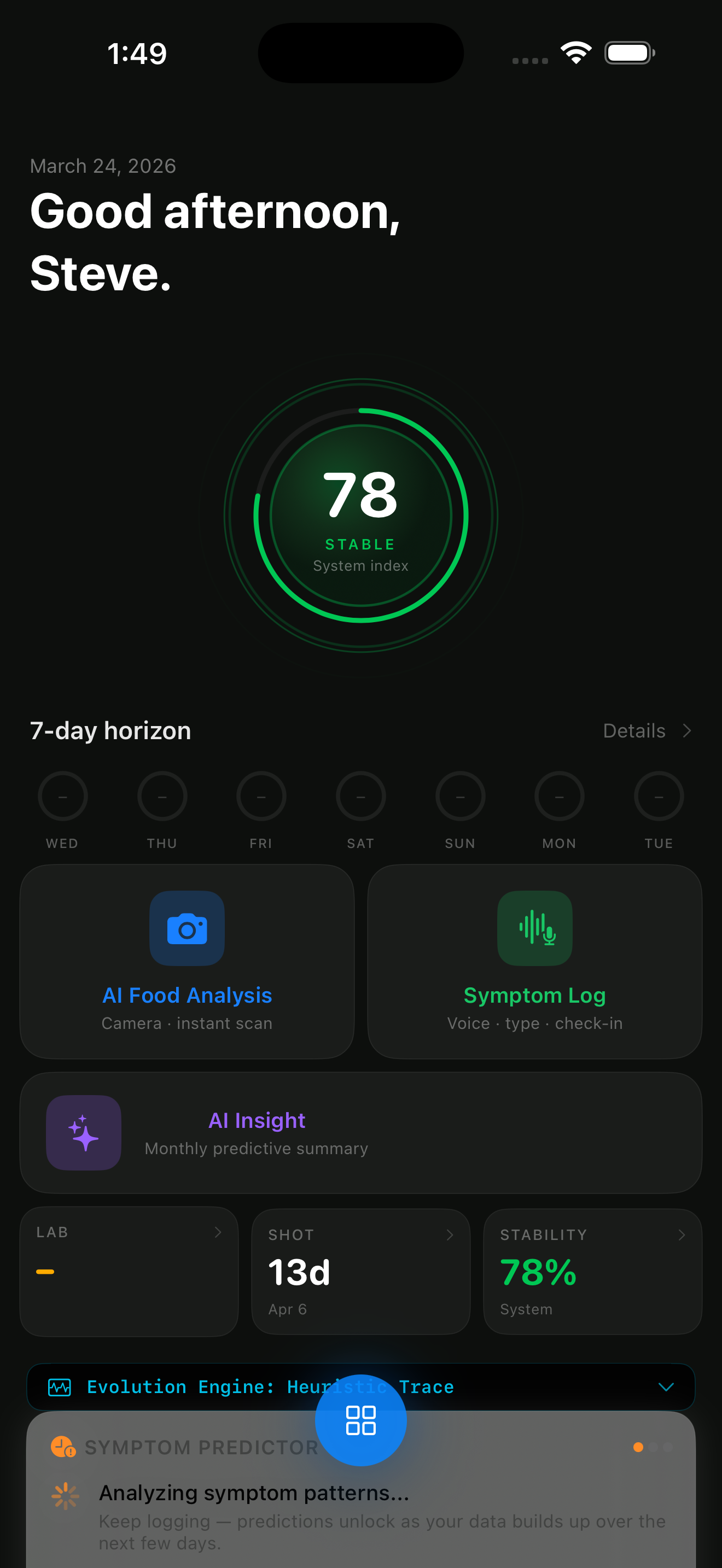
Stop Tracking.
Start Predicting.

The first clinical-grade predictive intelligence platform for NETs—built by a patient to turn white noise into a clear signal.

Clinical Synopsis
NET Tracker Production Build

The Clinical Intelligence Architecture

A dual-layer system merging 73 hard-coded clinical pillars with the flexible lived experience of the patient.

73 Clinical Pillars

Every inference is grounded in a foundation of medication pharmacokinetics, molecular velocity, and surgical anatomy.

Flexible Patient Voice

Medicine hasn't mapped every symptom yet. We include 25 'Patient Voice' slots for user-defined features treated as first-class data.

Molecular Velocity

We track the first-order rate of change in biomarkers like Signatera to predict trajectories before a flare begins.

Surgical Baselines

We encode 18 markers, such as bowel resection length, to adjust the engine's sensitivity to your specific physiology.

Temporal Logic

Mapping the 28-day SSA cycle to identify "vulnerability windows" where medication begins to wear off.

RWE Interoperability

All data exports to RFC 4180-compliant CSVs, ready for clinical team review or pharmaceutical research.

🧬
"I built NET Tracker because I needed it—and what I needed didn’t exist. When you’re living as a Stage 4 NET cancer patient, your body is constantly sending signals, but they often feel like white noise that stays trapped between appointments."

"I approached this as an architect to finally give us a way to turn that noise into a clear, predictable signal. This platform wasn't built to replace clinical judgment, but to empower it—providing the high-density data that patients and providers both need to stay ahead of the disease. It’s an intelligence engine designed to move us past 'just tracking' and into true foresight."

Steve Petersen

Creator · Stage 4 NET Patient ·